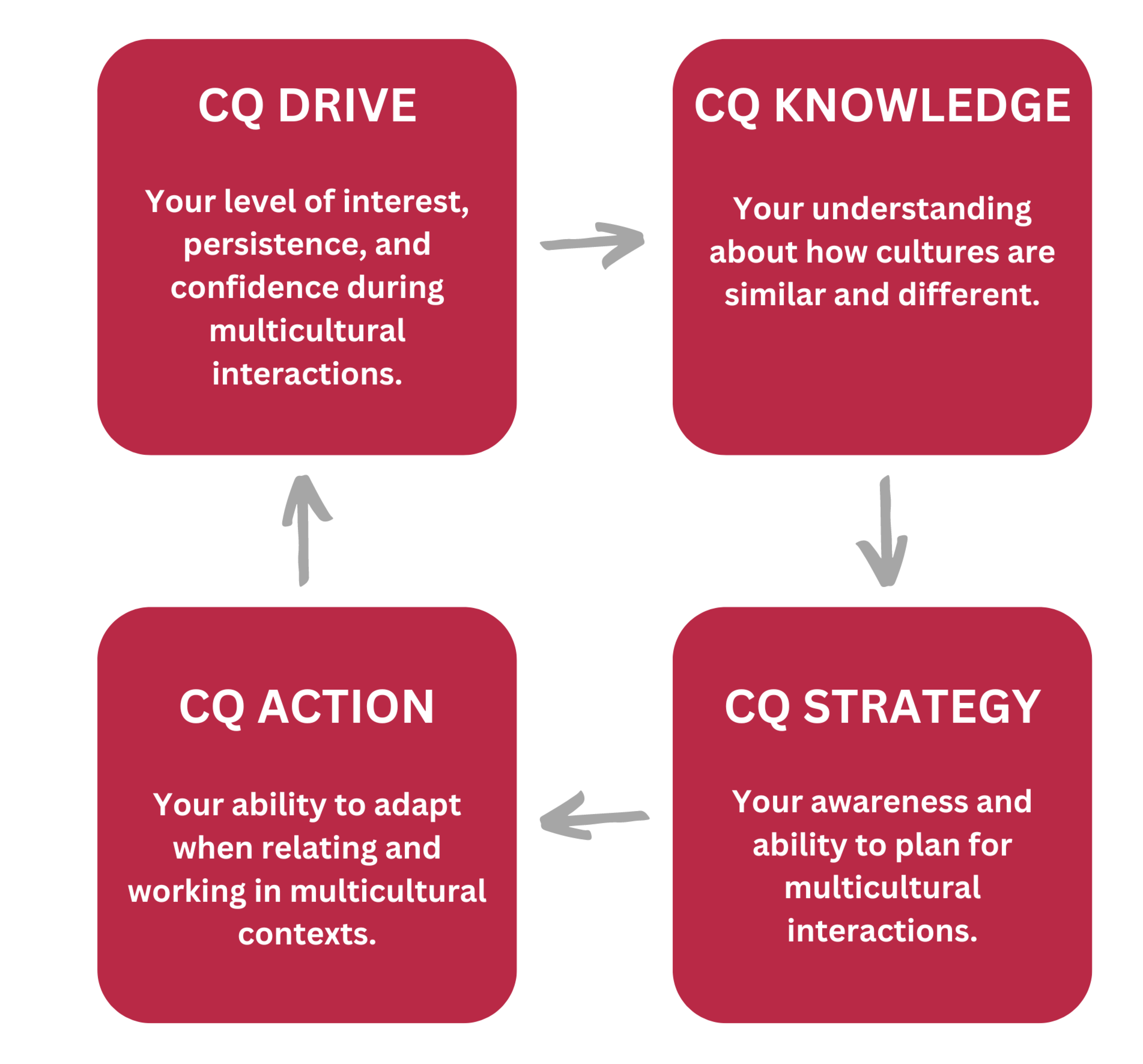


Cultural intelligence, or CQ, is a measure similar to IQ (intelligence quotient) and EQ (emotional quotient). CQ, first introduced by Christopher Earley and Soon Ang in the early 2000s and further developed by Ang and Linn Van Dyne, who created the CQ Scale, assesses an individual's capability to function effectively in culturally diverse situations. Cultural intelligence encompasses four main components: CQ Drive (confidence in cross-cultural interactions), CQ Knowledge (understanding cultural similarities and differences), CQ Strategy (processing culturally diverse experiences), and CQ Action (adapting behaviour to different cultures). Unlike IQ, CQ isn't quantified but is a lifelong soft skill that enhances interpersonal relationships by applying the 4 components of CQ to cross-cultural interactions, helping individuals empathise and connect with people from varied backgrounds.
More than 1,000 journal articles by scholars and research teams from all over the world have shown the validity of the CQ Assessment and have shown that Cultural Intelligence predicts work performance, leadership effectiveness, creativity, and a host of other skills.

It helps schools and universities fulfil their curriculum requirements in intercultural competency.
Offers a cost-effective, easy-to-implement solution for teaching complex intercultural topics.
Enhances employability by equipping participants with essential skills for the global workforce.
Provides a point of difference for institutions and workplaces seeking to provide future-focused training.
The CQ Assessments measure a person's capability for working and relating across cultures. Participants complete the assessment online and receive a personalised feedback report that compares their results against worldwide norms, explains what each score means, and walks them through building their own CQ Development Plan. Rather than a single overall number, the report breaks results down across the four capabilities of cultural intelligence: CQ Drive (the interest and confidence to engage with different cultures), CQ Knowledge (understanding how cultures are similar and different), CQ Strategy (planning for and making sense of cross-cultural situations), and CQ Action (adapting behaviour when it counts). The assessments work especially well around domestic and international trips. Running one before departure and another on return turns a trip from a memorable experience into measurable growth, showing participants exactly where they've developed across the four areas and where there's still room to stretch. The pre-trip report also doubles as a preparation tool, helping travellers go in with a clearer sense of what to watch for.
Participants complete the assessment online and receive a personalised feedback report that compares their CQ with the worldwide norms, helps them interpret the feedback, and guides them through the process of creating a personal CQ Development Plan. These tests are perfect for domestic and international trips where a pre and post CQ testing can highlight growth across the 4 areas of CQ.